How did Saudi Arabia get its name?
Saudi Arabia is unique among nations in that it is named after a ruling family. The Al-Saud dynasty traces its origins to the 18th century when Saud bin Muhammad led a local sheikhdom in the central Arabian peninsula. Officially the country is known as the Kingdom of Saudi Arabia.
Where is Saudi Arabia Located?
Saudi Arabia sits at the heart of the Middle East, occupying the majority of the Arabian Peninsula. Covering roughly 830,000 square miles, it is the thirteenth largest country in the world. The kingdom has two main coastlines — along the Red Sea and the Persian (Arabian) Gulf — with a combined coastline of about 1,640 miles.
Its neighbors include Jordan and Iraq to the north, Kuwait to the northeast, Qatar, Bahrain and the United Arab Emirates to the east, Oman to the southeast and Yemen to the south. Israel and Egypt lie across the Gulf of Aqaba.
Although much of the country is uninhabited desert, including the vast Empty Quarter — the world’s largest contiguous sand desert — there are hill ranges and mountains in the west and southwest bordering the Red Sea. The highest peak, Jabal Sawda, rises to about 9,843 feet above sea level. Saudi Arabia has no natural lakes or permanent rivers.
Riyadh is the nation’s capital and largest city, home to over eight million residents. It stands on a large central plateau and functions as the political and administrative center of the kingdom.
A Brief History of Saudi Arabia
Human settlement on the Arabian peninsula dates back thousands of years, and the region has long been a crossroads for trade. Most notably, Saudi Arabia is the birthplace of Islam. Before the 7th century, the peninsula was largely populated by nomadic tribes. The life and teachings of the Prophet Muhammad, born in Mecca, united many of these tribes into a growing Muslim community. After his death in 632, the new Muslim caliphates expanded far beyond Arabia.
In the 16th century the Ottoman Empire exerted control over the peninsula’s coastal regions. By the 18th century the House of Saud emerged, allied with religious reformer Muhammad ibn Abd al-Wahhab. This alliance provided both political and ideological foundations for what would become the modern Saudi state, though the Ottomans reasserted control in the early 19th century. In 1902 Abdulaziz ibn Saud returned from exile and reconquered Riyadh, eventually unifying much of the peninsula.
Following World War I and the decline of Ottoman influence, Abdulaziz consolidated his rule and in 1932 proclaimed the Kingdom of Saudi Arabia. The kingdom has remained an absolute monarchy, with successive kings from the Al-Saud family. The Saudi monarch also holds the title “Custodian of the Two Holy Mosques,” reflecting the kingdom’s guardianship of Islam’s holiest sites in Mecca and Medina.
The 1938 discovery of oil transformed Saudi Arabia’s economy. By 1949 petroleum production was well established under the Arabian American Oil Company (Aramco). Oil wealth propelled rapid modernization and positioned the kingdom as one of the world’s leading oil producers and exporters. Saudi Arabia became a founding member of OPEC in 1960 and nationalized Aramco over time, taking full control by 1980.
Saudi foreign relations have been shaped by strategic partnerships and regional conflicts. A notable early diplomatic meeting occurred in February 1945 when King Abdulaziz met U.S. President Franklin D. Roosevelt aboard the USS Quincy and agreed on oil-for-security cooperation. In recent decades the kingdom has faced internal and regional challenges, including the rise of extremist groups like Al-Qaeda and geopolitical involvement in neighboring conflicts such as the ongoing war in Yemen since 2015.
Domestically, reform and social change have been gradual. Political unrest during the Arab Spring prompted social and economic measures to ease tensions, and in recent years Crown Prince Mohammed bin Salman has introduced policies expanding women’s rights, encouraging private sector growth and allowing cultural venues such as cinemas. However, controversies over human rights and high-profile incidents have generated international scrutiny.
Saudi Arabian Culture
Saudi Arabia’s population is roughly 33 million, predominantly Arab and largely adherent to Sunni Islam. Arabic is the official language and the national currency is the Riyal, which is pegged to the U.S. dollar. Islamic faith and Bedouin traditions strongly influence social norms, customs and law, with Sharia forming the basis of the legal system.
Religious observances guide the yearly calendar. Ramadan, the month of fasting from dawn until sunset, concludes with Eid al-Fitr, a time for family gatherings and gift-giving. The hajj pilgrimage to Mecca is an obligation for all able Muslims and culminates in Eid al-Adha, when families traditionally sacrifice an animal and share meat with the needy. These rituals remain central to social life.
Public life in Saudi Arabia reflects conservative values: religious education is emphasized, and freedom of religion is restricted for non-Muslims. The kingdom also prioritizes preservation of Islamic heritage. The Holy Mosque in Mecca and the Prophet’s Mosque in Medina are the most significant religious sites, while minarets and mosque architecture dominate urban skylines, signaling the rhythm of daily prayer.
Traditional arts such as poetry, folk music and dance remain important cultural expressions. The national dance, the men’s sword dance known as the Ardha, features coordinated steps, chanting and poetry. Dress customs emphasize modesty and practicality: men typically wear a long white thawb and head covering, while many women wear an abaya and headscarf. Jewelry and adornment remain part of cultural identity.
Saudi Arabian Cuisine
Saudi cuisine blends traditional dishes with modern influences. Despite sparse rainfall, the kingdom has invested heavily in agriculture, desalination and water resources to support food production, and a wide range of international and fast-food options are available alongside local specialties.
Islamic dietary laws shape daily eating habits. Pork and alcohol are forbidden, and meat must be slaughtered according to halal practices. Lamb and chicken are staples, often reserved for guests and celebrations. Camel meat and camel milk continue to be consumed, a legacy of Bedouin foodways. Dairy, yogurt and fermented drinks appear in many dishes.
Dates, wheat, rice, fava beans and yogurt are central to the Saudi diet. The kingdom produces hundreds of millions of pounds of dates each year and flatbreads such as fatir or kimaje serve as utensils to scoop up food. Hearty soups, stuffed vegetables, bean salads and tabbouleh are common, while coffee (gahwa) and sweet tea accompany social visits. Arabic coffee is served in small cups and offered as a sign of hospitality; refusing a cup is considered impolite.
Spices like cardamom, saffron, cumin, coriander, cinnamon and cloves are widely used, and many dishes are served with a fiery hot sauce called shattah. Popular sweets include ma’amul, short biscuits filled with dates or nuts, which are often dusted with powdered sugar and served with coffee.
Dining traditions emphasize hospitality and ceremony. Meals are often shared on a rug while seated cross-legged, accompanied by ritual hand washing and phrases like “Bismillah” (in the name of God) and “Sahtain” (a wish for good health). Hosts strive to ensure guests leave well-fed, reflecting the long-standing cultural value placed on generosity.
The Menu
Appetizer
Akkawi Manakeesh (Arabic Cheese Bread with Nigella Seeds)
Main Course
Al Kabsa (Spiced Rice and Chicken)
Served with
Shattah (Spicy Hot Sauce)
Dessert
Ma’amul (Short Biscuits, Stuffed with Dates and Nuts)
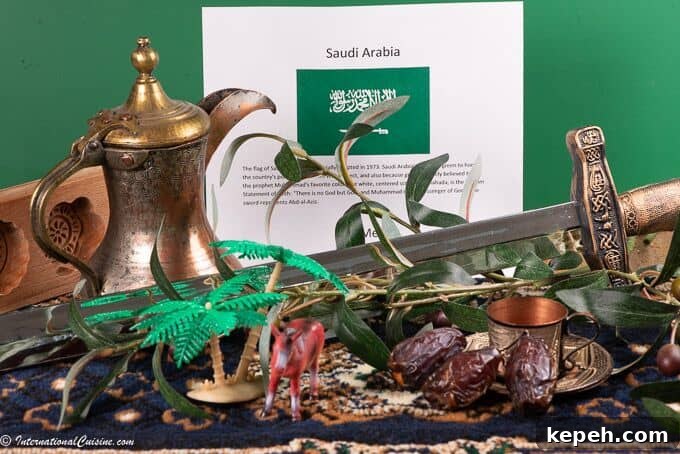
To set the scene we spread a rug and arranged palm fronds and dates as simple decor. A traditional dallah coffee pot and a calligraphy pen honored the kingdom’s long artistic and literary traditions, while a small horse figurine reflected the region’s equestrian heritage. Meals often begin with a ritual hand washing and the phrases “Bismillah” and “Sahtain.” Guests eat with the right hand and share dishes communally.
Our appetizer was a warm Akkawi manakeesh — flatbread topped with salty akkawi cheese rinsed from its brine and sprinkled with nigella seeds. Another variation included a za’atar spice blend. The bread was enjoyed by hand, as customary.
The main course, Al Kabsa, featured fragrant spiced rice and tender chicken. This regional rice dish shares characteristics with other Gulf dishes like machboos, but it is distinguished by its local spice blend and the accompaniment of shattah, a fiery sauce served at the side that enhances flavor and heat.
For dessert we served ma’amul, buttery shortbread cookies filled with dates and nuts, molded into decorative shapes and dusted with powdered sugar and rose petals. These paired perfectly with strong Arabic coffee.
At the meal’s end we offered the blessing “Diamah,” wishing continued abundance at the table. Hospitality remains a defining trait of Saudi culture: generous hosting and warm welcome for guests are deeply valued and widely practiced.
Until next time,
Darlene